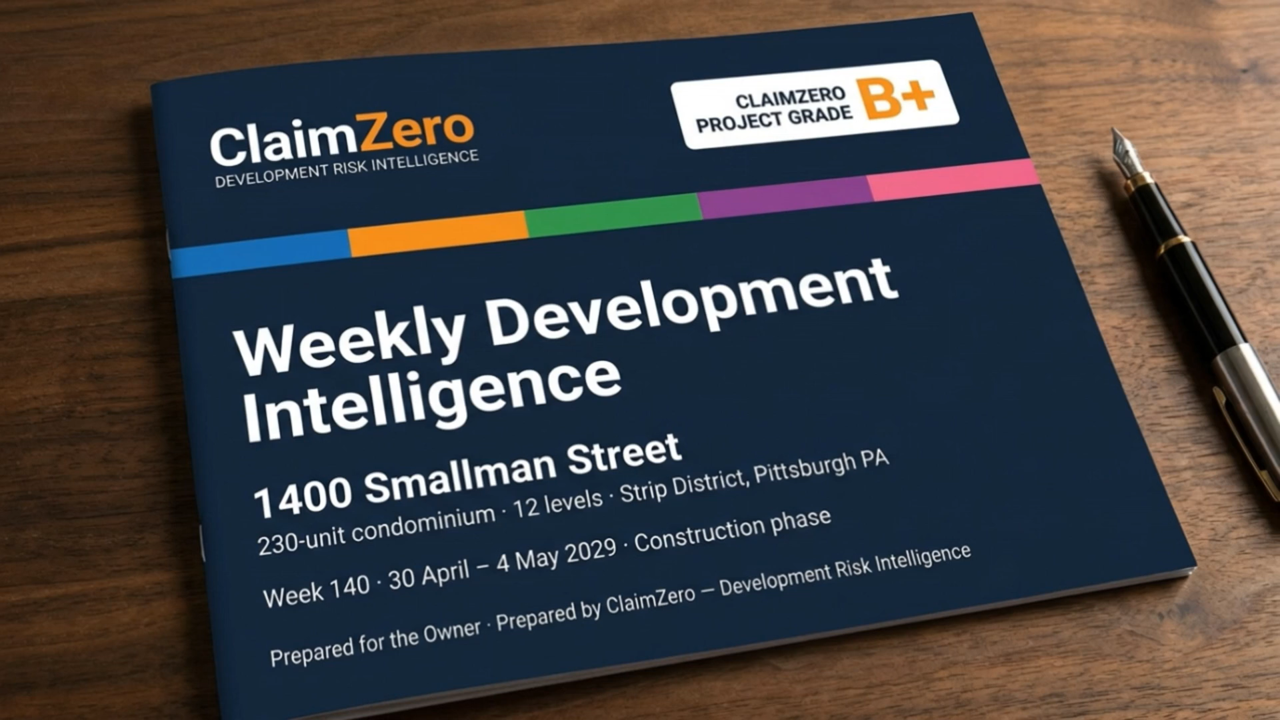
A scored Project Risk Index delivered in one Weekly Intelligence Report every Monday at 7:00 a.m. Weeks-in-advance visibility protects equity returns, interest reserves, and loan completion tests before field delays erode yield. Built explicitly to safeguard the capital stack for developers, institutional boards, and construction lenders.
Construction software tracks field spending for the contractor, but leaves major developers, universities, and lenders blind to underwritten pro formas and debt covenants. ClaimZero operates as an independent risk operating system—reading your live project data automatically to score the deal, defend equity returns, and sign an unalterable weekly record.
| Axis | Construction Platforms | Owner Portfolio Tools | ClaimZero Monitored Intelligence |
|---|---|---|---|
| Primary Seat | The builder & contractor | The developer's internal team | The owner, independently |
| Baseline | Contract documents & schedule | The approved capital budget | The underwritten deal pro forma |
| Window | Pre-con through closeout | Concept through operations | Acquisition through sellout |
| Data Entry | Project field team | Your own internal staff | Nobody. Automated inference. |
| Primary Output | Status & compliance logs | Variance reporting | Scored index & signed record |
| Blind To | The deal economics & pro forma | Debt covenants & takeout tests | Zero exposure blindspots |
ClaimZero scores the entire arc, mapping behavioral leading indicators to the individual seat. Contractor tools capture a single slice in the center. The return on your capital is decided on the ends.
The pro forma is set here, and so is the first risk. ClaimZero pressure-tests the deal against its own assumptions: basis, carry, entitlement path, and the schedule the underwriting depends on. The objective is not only to build the right project — it is to get the right project into the ground as fast as legally and financially possible, because every avoidable month of carry before shovel is unrecoverable.
Zoning, code, and agency timelines decide whether the underwritten schedule survives. Tracks objection aging, approval cadence, and the dependencies that stall a filing — surfacing the slow path before it becomes a year of carry the deal never priced.
The first honest collision between what the deal underwrote and what the building wants to be. ClaimZero tracks program-to-budget reconciliation, area and efficiency drift, and the decisions deferred out of SD — the ones that reappear as cost in design development, when there is less room to absorb them.
Most cost and schedule are committed before a shovel moves. ClaimZero watches scope creep against budget, design-decision latency, and the coordination gaps that harden into change orders the moment construction starts.
Buyout is where the GMP meets the underwritten hard cost. Measures buyout variance, contingency adequacy, and long-lead exposure — flagging the trades and assumptions drifting from the budget the equity was raised against.
The highest-value signal on the project: the gap between scheduled, billed, and verified percent-complete. Scores schedule velocity, change-order trajectory, and contingency burn against the underwriting — and reads the leading indicators of a claim weeks before it is filed.
The question the lender actually cares about: is the project on track to satisfy the completion and takeout test? Tracks the path to that test against interest-reserve burn — the single risk a construction lender feels as hard dollars, and one no construction tool is built to compute.
TCO and CO are where a finished building still cannot earn. Monitors the closeout and sign-off path — the agency, inspection, and punch dependencies that keep capital idle after the work is effectively done.
The back end determines whether the deal made money. Scores absorption against pro forma, deposit and closing velocity, and offering-plan exposure — closing the loop back to the projections the whole thing was underwritten on.
ClaimZero operates as an automated inference engine. It reads across every data stream your project is already producing, scores participants objectively, and ranks exposures without distracting your team.
One 30-minute configuration links your stack. The platform pulls data from construction management platforms, CPM schedules, cost ledgers, and municipal agency portals.
The platform watches what they do, not what they self-report. It extracts role-attributable signals from RFI log clusters, submittal aging, ball-in-court latency, and platform-resident correspondence.
Every week treats the project differently. Concrete metrics shift automatically across lifecycle stages; a structural engineer's rubric matters during foundation pours, not during finishes.
7 a.m.: A single, dense, 30-page Weekly Intelligence Report tracking 196 KPIs — the exact variables driven by financial exposure and trajectory. Distribute to your team and hit the risk target.
Under the hood sits the Development Intelligence Risk Engine™. By evaluating 22 risk areas, 31 live risk indicators across 152 aspect report cards and running over 1,550 deterministic algorithmic checks against live project records, it scores the documentation patterns that historically precede a claim weeks before an issue matures into a cost.
Not a portal your team must navigate or status software to untangle. One executive package delivered to your inbox at 7:00 a.m. every Monday. Our composite Project Risk Index grades the velocity and trajectory of anomalies — giving you complete capital clarity.
| Contingency Allocation. Have the Owner's Representative audit change events over $50K immediately. Contingency burn is pacing 11 points ahead of baseline underwriting curves. Trajectory is our active threat. |
| Draw Verification. Verified percent-complete at the pencil walk trails contractor-billed logs by nine points. Reconcile with the lender's construction consultant prior to draw submission to protect funding cadence. |
| Takeout Security. Critical path delay threatens takeout facility completion test parameters. Convene a focused coordination session within 72 hours to evaluate recovery options before interest reserve erosion. |
How ClaimZero monitored an active $84.5M mid-construction project, catching critical-path divergence and billing gaps before they impacted the capital stack.
ClaimZero is priced to protect the capital stack. By catching critical-path divergence early, the entire multi-year engagement is offset by preventing a fraction of a single month's delay.
| Project Value | Fitted Construction Duration | Peak-Phase Carry (Daily) | Break-Even (Days of Delay Avoided) |
|---|---|---|---|
| $50M | 21.4 months | $11,300 / day | 30.3 days |
| $100M | 24.3 months | $21,869 / day | 21.6 days |
| $250M | 28.8 months | $52,575 / day | 16.5 days |
| $500M | 32.7 months | $102,402 / day | 15.3 days |
| $1B | 37.2 months | $199,947 / day | 15.4 days |
*Break-even represents the ratio of the total engagement fee against daily peak carry. Carry models assume an S-curve drawdown and 30% day-one land takeout. A single caught exposure effectively zeroes out the cost of the platform.
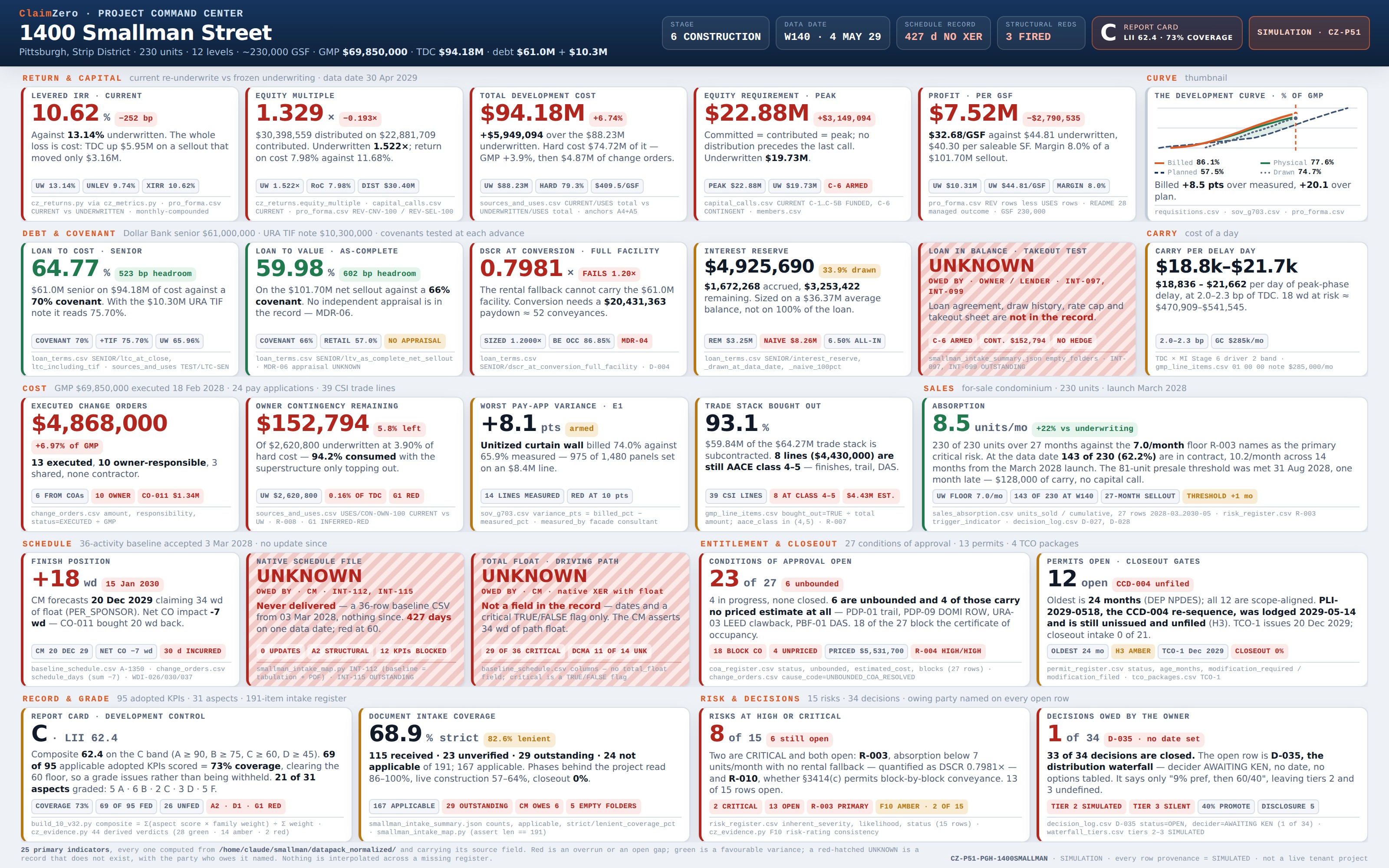
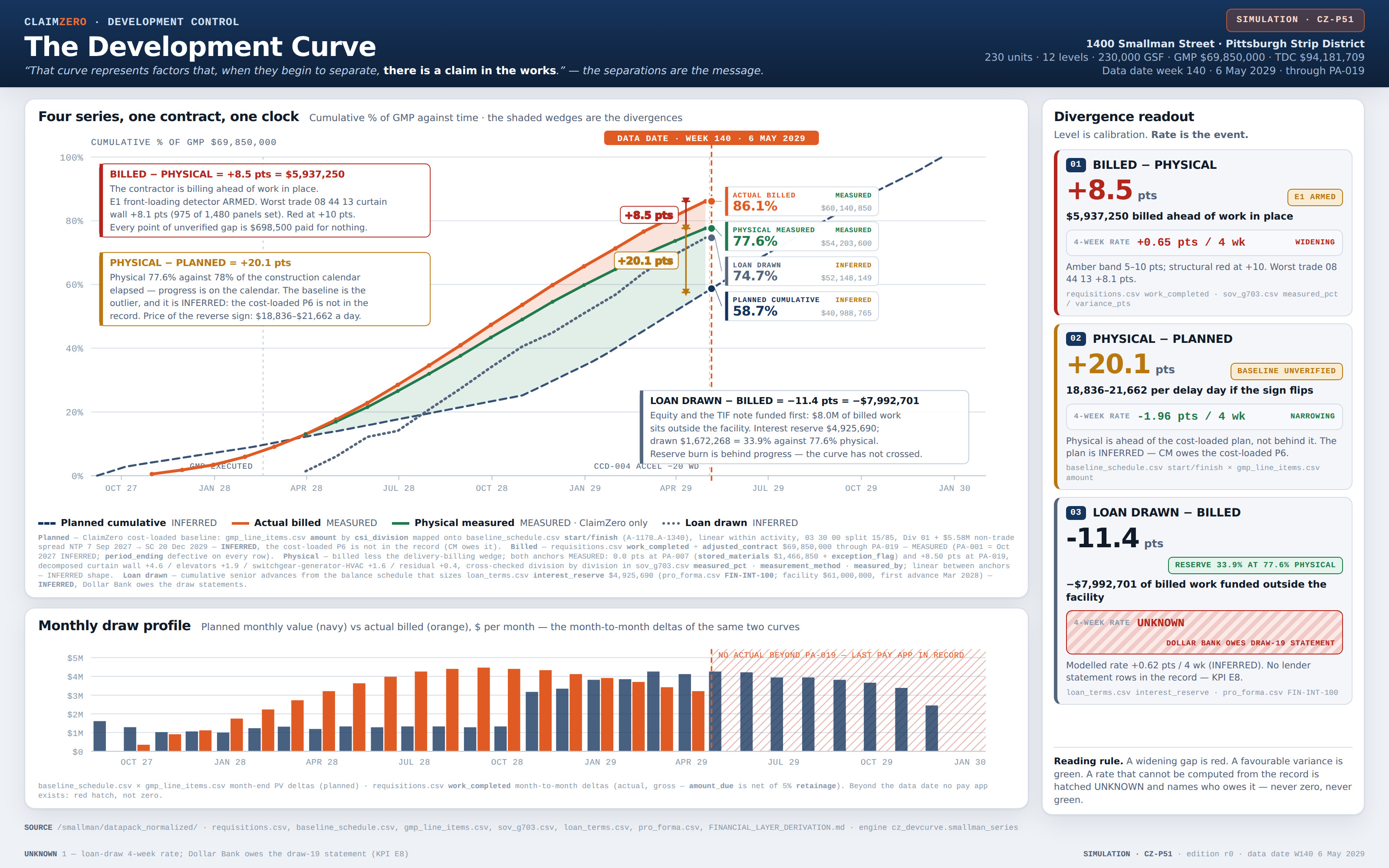
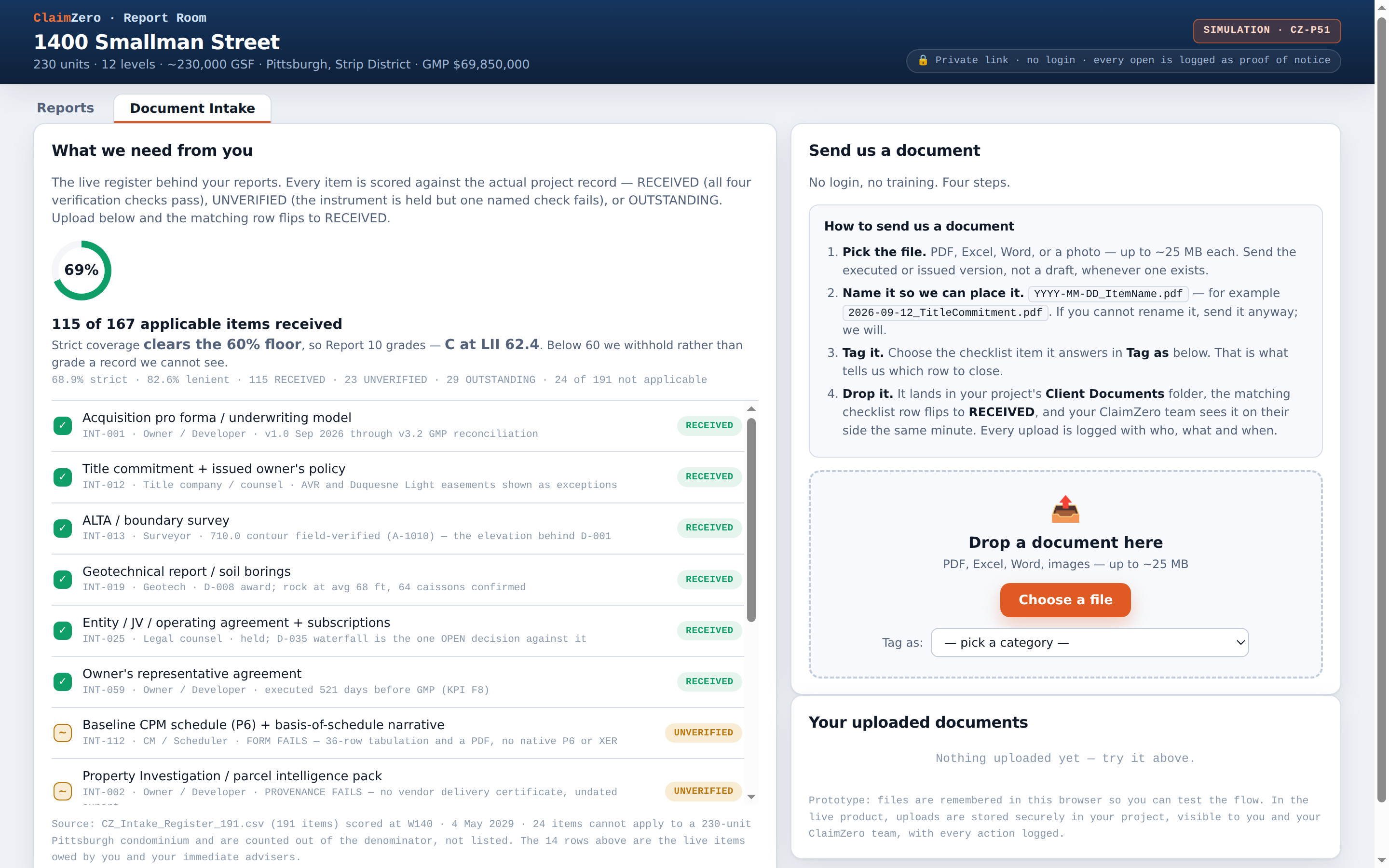
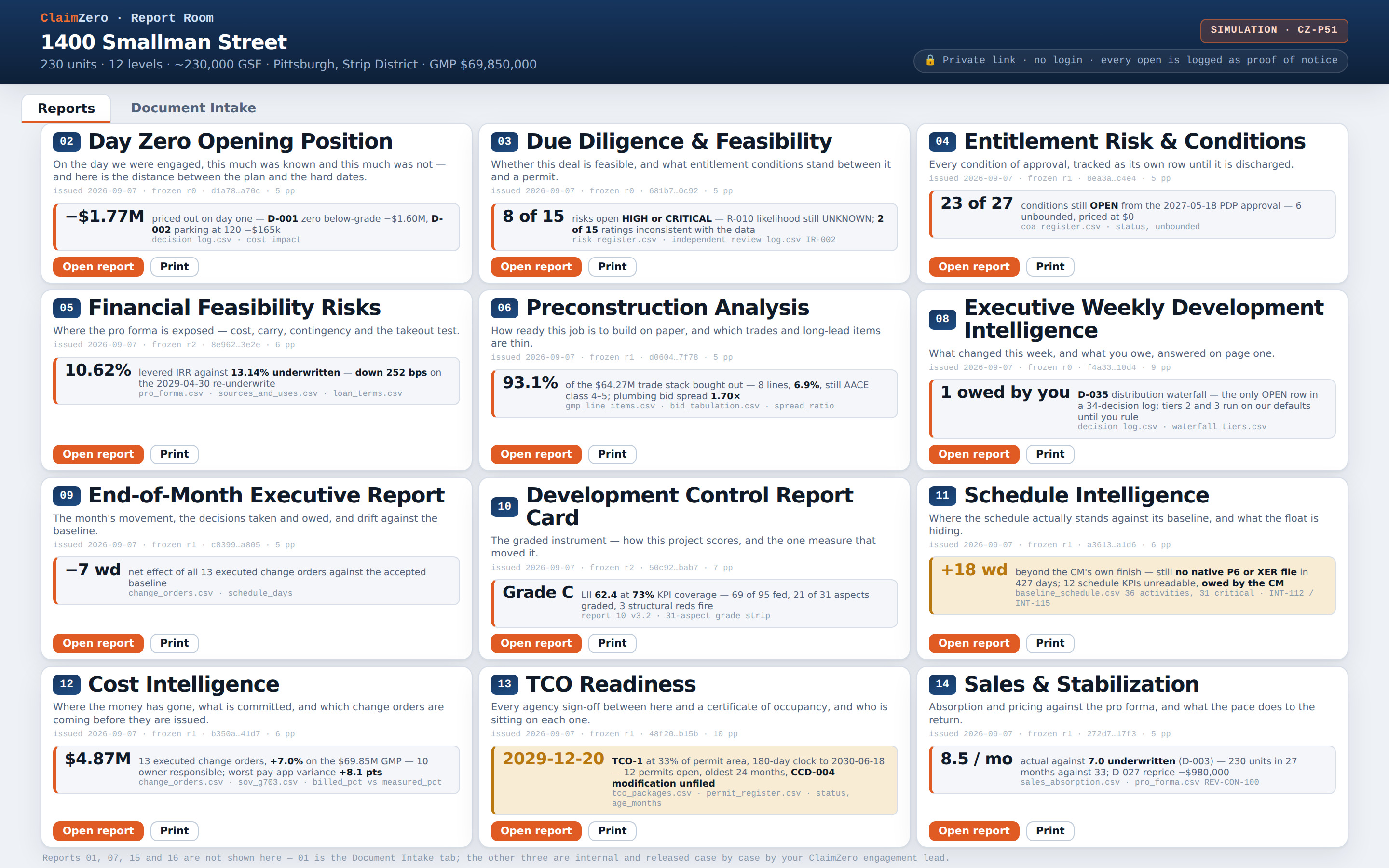
Explore how ClaimZero visualizes live project posture, document intake, and development curves across your entire portfolio.
Real-time risk scoring, equity requirement tracking, and loan covenant monitoring across your book of assets.
Four series, one contract, one clock: catching the gap between billed, physical, and loan-drawn progress.
Strict 60% coverage floor. Every uploaded item is verified and scored against the project record without manual entry.
31 aspect categories evaluated weekly, producing court-grade evidence records and 30-page intelligence packages.
The inference layer continuously scores data modules rolling into four macro domains. Three track execution data. The fourth captures the capital stack itself — the metrics field platforms cannot track.
The owner-side financial wrappers that live entirely outside of standard project-management software.
Role-attributable indicators pulled from platform activity logs, measured directly against stage-aware rubrics.
Not simple field schedule tracking — schedule health analyzed directly against the parameters the asset was financed on.
The back-end performance variables that dictate deal returns — completely invisible to tools that stop at physical build closeout.
Most risk models are built forward, from theory. This engine was built backward, from outcomes.
Four decades spent moving through every seat in the development life cycle — civil engineer, construction manager, builder, developer — followed by years spent being called in after the fact as an expert witness to determine what went wrong on someone else's project, and when it became inevitable.
That forensic practice is the key: walking a failed project backward from the consequence to the first signal that predicted it. ClaimZero's rubrics are that backward walk, run forward. Every rubric in the engine traces to a specific event on a real project. The calibration is encoded, versioned, and applied to a published methodology.
An expert practice grounded in research dating back to 1988. By converting decades of claims pattern recognition into a repeatable, software-encoded methodology, the platform delivers senior forensic oversight on every cycle without depending on one person in the room.
ClaimZero delivers asymmetric risk protection for private developers, university capital improvement programs, and real estate investment sponsors.
Research shows average US disputes exceed $56M and 12 months in delay. Protect equity returns against carry clock slips and unpriced trade changes.
With US higher-ed carrying $156/sq.ft. in deferred capital renewal backlogs, ClaimZero provides rigorous trustee-level governance over complex capital programs.
Independent risk validation supporting monthly inspector draw decisions and covenant enforcement.
A unified operating system replacing spreadsheet sprawl with institutional, verifiable records.
Contemporaneous documentation files that can be structured under counsel direction to manage risk exposure long before dispute maturity.
Transparent portfolio monitoring built separate from developer narratives, tracking true completion test readiness.
We will run our Development Risk Engine against your active project files to isolate hidden vulnerabilities your standard construction tool stack is blind to.